MINING SIMULATION
Process-Parallel Blockchain Mining Performance Analyser
The Problem Statement
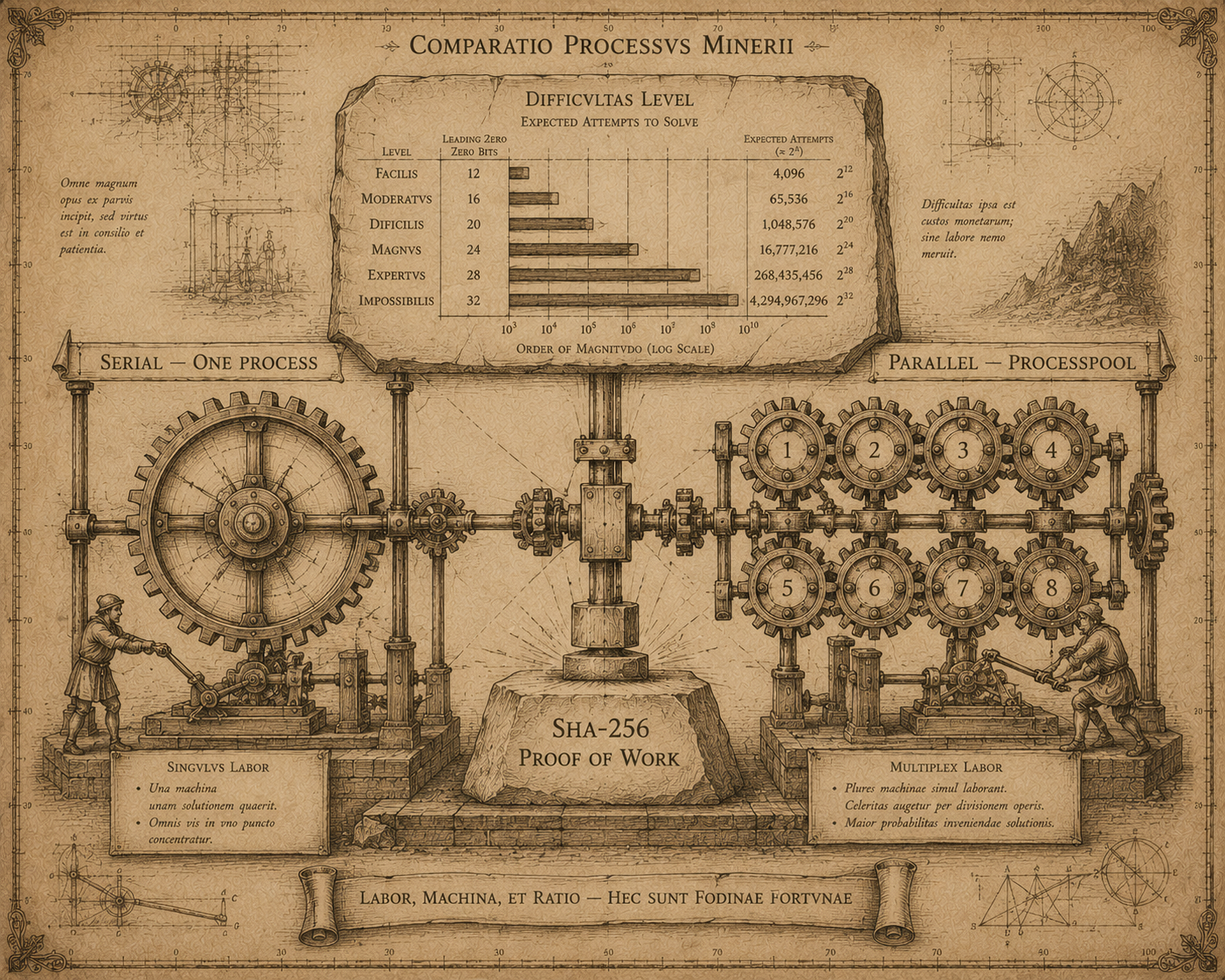
“Blockchain mining literature discusses parallelism as a key performance lever, but few accessible tools allow engineers to empirically compare serial versus parallel nonce search under controlled conditions. This simulator fills that gap by implementing two mining strategies — a single-process serial miner and a ProcessPoolExecutor-based parallel miner — across configurable difficulty levels and worker counts, and visualising the throughput differential. It serves as the instructional middle ground between mining theory and live blockchain data, enabling controlled reproducible performance benchmarks.”
The Architecture Layout
The simulator is a Python CLI application with two core execution modes. Serial mode runs nonce search sequentially in a single process, incrementing from zero and checking the SHA-256 hash of (block_data + nonce) against the difficulty prefix. Parallel mode distributes nonce search ranges across N worker processes via ProcessPoolExecutor, with each worker independently searching a contiguous nonce sub-range and returning on first valid hash. Block structure includes index, timestamp, previous hash, transactions, nonce, and computed hash. The compare mode runs both strategies against the same block set, collecting timing data across multiple trials and rendering matplotlib bar and line charts for throughput and time-per-block analysis. Worker count, difficulty, and block count are fully configurable via argparse CLI flags.
Architecture Design Diagram