ADAPTIVE DEVELOPER TWIN
Neural Developer Intelligence Platform
The Problem Statement
“Engineering teams have no reliable, passive way to measure developer skill growth, influence, or burnout risk — existing tools require manual self-reporting or interrupt developer flow. ADT resolves this by silently capturing VS Code telemetry, running it through 10 proprietary algorithms, and constructing a live Neural Twin per developer. It acts as the intelligent middle ground between invasive surveillance and blind management, surfacing actionable intelligence without a single self-report.”
The Architecture Layout
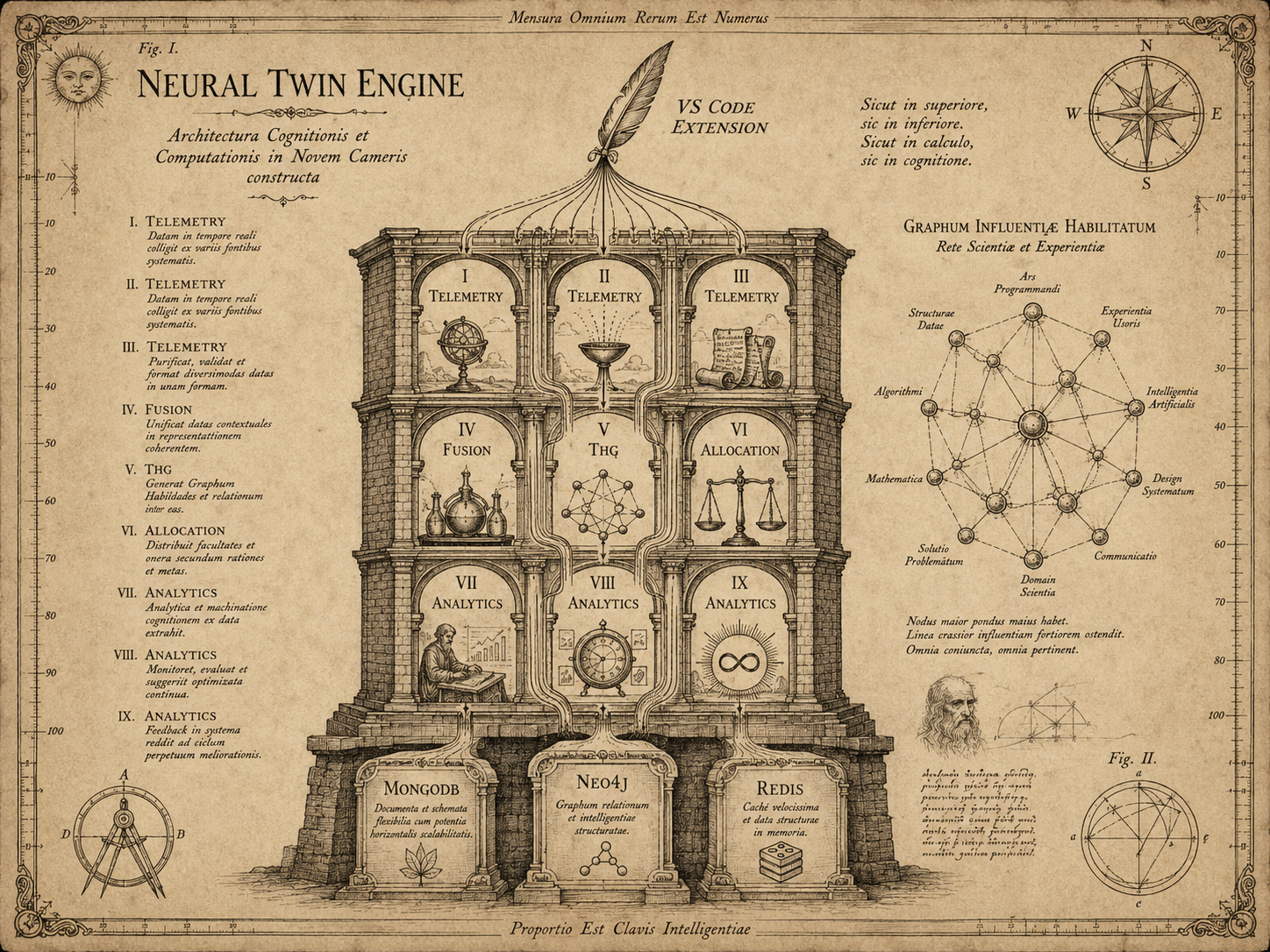
ADT is a nine-service microservices platform behind an API Gateway on port 8000. The VS Code Extension emits SHEC-encrypted heartbeats, which flow into the Telemetry Service for SWEF sliding-window productivity processing. The Fusion Service applies CodeBERT semantic analysis and SCM-Audit AST parsing to map repository commits to the THG skill taxonomy. The THG Service maintains a Neo4j AuraDB Neural Twin per developer, running EVC-Influence PageRank to surface knowledge hubs. The Allocation Engine scores task-candidate pairs via the CSA vector engine. The Analytics Service computes composite leaderboard scores and runs VDA burnout regression. All real-time events pass through Async-Redis-WS pub/sub to a Live Audit HUD. Persistent state is split across MongoDB Atlas (users, telemetry, audit logs), Neo4j AuraDB (skill graph), and Upstash Redis (pub/sub events).
Architecture Design Diagram